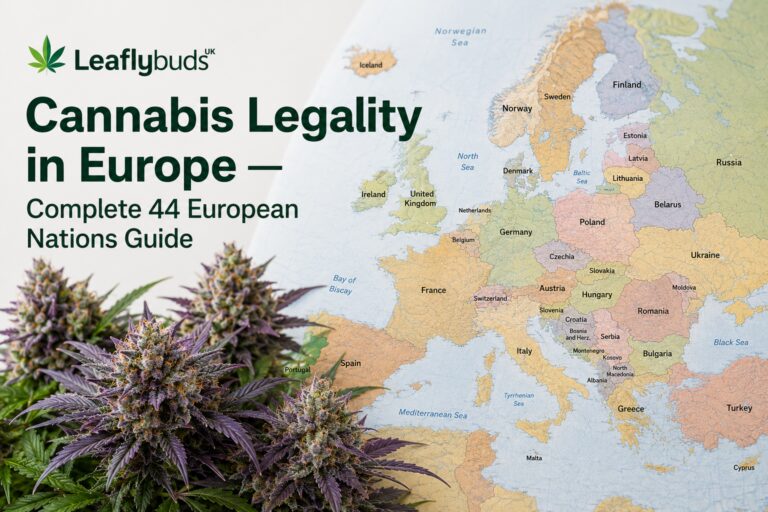
Cannabis Legality in Europe
A complete country-by-country legal reference covering all 44 European nations — possession laws, penalties, medical programmes, decriminalisation status, cross-border regulations and recent legislative developments
Cannabis Legality in Europe: A Continent in Transition
Europe is home to some of the most progressive and some of the most restrictive cannabis laws on earth — sometimes within a few hundred kilometres of each other. From the iconic cannabis cafes of Amsterdam to the zero-tolerance prisons of Belarus, the continent presents a patchwork of legislation that reflects profoundly different cultural, political and public health approaches to the plant.
Understanding cannabis law in Europe requires understanding not just what the written law says, but how that law is actually enforced. Formal illegality and practical tolerance often diverge dramatically. Portugal decriminalised personal possession of all drugs including cannabis in 2001 — yet cannabis remains technically illegal under Portuguese law. The Netherlands operates its world-famous coffee shop system under a formal policy of non-enforcement called gedoogbeleid, meaning cannabis sales technically violate Dutch law every single day. Germany completed a landmark partial legalisation in April 2024, becoming the largest European country to move toward a regulated cannabis market.
This guide documents the legal status, enforcement reality, possession thresholds, penalties, medical access frameworks, cultivation rules, cross-border implications, and recent legislative history for every country in Europe — from the major western nations to the smallest microstates. It is intended as an educational reference only. Laws change. Enforcement varies. What is tolerated in one city may result in imprisonment in the next country.
How European Cannabis Law Is Structured
Most European countries are party to three United Nations drug conventions — the 1961 Single Convention on Narcotic Drugs, the 1971 Convention on Psychotropic Substances, and the 1988 Convention Against Illicit Traffic in Narcotic Drugs. These treaties technically require signatory states to criminalise cannabis production, trafficking and possession, but leave significant room for interpretation, particularly around personal use and harm reduction.
Within this international framework, European nations have developed four broad approaches:
Full legalisation — where adult personal use, possession up to a defined limit, and in some cases regulated sale or home cultivation are permitted by law. Currently applies in Malta and Luxembourg for personal possession, and Germany from 2024 for possession and social clubs.
Decriminalisation — where possession of small amounts remains technically illegal but is treated as a civil or administrative matter rather than a criminal offence. No prison sentence — typically a fine or compulsory treatment referral. Applied in Portugal, Czech Republic, Spain (for private use), Italy, Netherlands (in practice), and many others.
Medical access with recreational prohibition — where cannabis-based medicines are available on prescription but recreational use remains a criminal offence. The majority of European countries now fall into this category.
Full prohibition — where all cannabis use is treated as a criminal offence. Increasingly rare in western Europe but still applies in several eastern European and Balkan states.
Cross-Border Cannabis in Europe: What You Need to Know
Perhaps the most dangerous misconception about European cannabis law is that legalisation or tolerance in one country provides any protection when crossing borders. It does not. Under EU law, each member state retains full sovereignty over its drug laws. Carrying cannabis across any European border — including from a country where it is fully legal into a neighbouring country where it is not — is drug trafficking and is treated accordingly.
The Schengen Area, which covers 27 European countries and has eliminated most passport checks at internal borders, does not eliminate customs enforcement. Random vehicle and bag searches are common at Schengen borders. Drug-detection dogs operate at airports, train stations and highway checkpoints throughout Europe. Being found with cannabis at a border — regardless of quantity — will be treated as importation or trafficking, carrying far harsher penalties than simple possession would in either country.
The Rise of CBD Across Europe
Cannabidiol (CBD) derived from industrial hemp (Cannabis sativa with less than 0.2% THC by dry weight in most EU countries) occupies an increasingly distinct legal space across Europe. The EU Novel Food Regulation classified CBD extracts as a novel food requiring pre-market authorisation, creating regulatory complexity that varies between member states. Switzerland permits up to 1.0% THC in hemp products — five times the EU standard — creating a unique market with stronger products. Slovakia and Russia treat CBD as equivalent to cannabis and apply full prohibition. Always check local law before carrying CBD products across any European border.
Current Legal Status
Germany became the largest country in Europe to implement partial cannabis legalisation when the Cannabis Act (Cannabisgesetz) came into force on 1 April 2024. Adults aged 18 and over may possess up to 25 grams in public and up to 50 grams at home. Home cultivation of up to three female plants is permitted for personal use. Commercial sale through licensed shops has not yet been fully implemented — a second pillar establishing licensed dispensaries is under development.
Cannabis Social Clubs
The Cannabis Act introduced Anbauvereinigungen — licensed non-commercial associations of up to 500 adult members who may collectively cultivate cannabis for personal use. Each member may receive no more than 25g per day and 50g per month. Members must be German residents. Clubs must keep records, implement security and provide addiction counselling referrals. As of 2026 hundreds of clubs have applied for licences across Germany, with Berlin, Hamburg, Cologne and Frankfurt being most accommodating.
Prohibited Areas
Cannabis use remains prohibited: within 100 metres of schools, nurseries, playgrounds and sports facilities; in pedestrian zones between 7am and 8pm; in the presence of minors; in all workplaces; in vehicles; and in all public transport.
Medical Cannabis
Germany introduced medical cannabis in March 2017. Under the 2024 Cannabis Act, medical cannabis was reclassified from the Narcotics Act — any doctor can now prescribe cannabis-based medicines. Germany has over 250,000 registered medical cannabis patients. Available products include dried flowers, extracts, dronabinol, nabilone and Sativex.
Penalties
| Offence | Penalty |
|---|---|
| Possession under 25g (public) — adult | Legal — no offence |
| Possession 25–60g (public) | Administrative fine up to €30,000 |
| Possession over 60g | Criminal — up to 3 years imprisonment |
| Supplying to minors | Up to 5 years imprisonment |
| Commercial trafficking | Up to 5 years; aggravated up to 15 years |
| Driving under influence | Licence revocation + criminal prosecution |
Cross-Border Considerations
Germany borders nine countries: Denmark, Poland, Czech Republic, Austria, Switzerland, France, Luxembourg, Belgium and the Netherlands. Cannabis legally possessed in Germany cannot be transported across any border. German customs (Zoll) actively patrol all borders. Reports of seizures at the German-Netherlands border increased significantly in 2024 as people incorrectly assumed legalisation permitted cross-border transport.
Historical Timeline
Current Legal Status — The Paradox System
The Netherlands has one of the most unique drug policy systems in the world. Cannabis remains technically illegal under the Opium Act (Opiumwet) of 1976 — yet the country has over 570 licensed coffee shops that legally sell cannabis to adults every day. This system operates under a formal tolerance policy called gedoogbeleid. The "front door" (retail sale to customers) is tolerated; the "back door" (supply to the coffee shop) remains illegal.
The Coffee Shop System
Dutch coffee shops are licensed by local municipalities under the AHOJ-G criteria: no Advertising, no Hard drugs, no nuisance (Overlast), no sales to Jongeren (youth under 18), and no sales of more than 5 Grams per transaction. Coffee shops may not hold more than 500 grams of stock. They may not sell alcohol. Amsterdam has approximately 160 coffee shops; Rotterdam, The Hague and Utrecht each have approximately 30.
The Closed Supply Chain Experiment
Since 2023, the Netherlands has been running a landmark experiment in ten cities including Breda, Tilburg, Arnhem and Almere to test a regulated, legal supply chain for coffee shops. Licensed growers produce cannabis under government supervision and supply it directly to participating coffee shops. This is the world's first attempt to create an entirely legal cannabis supply chain from cultivation to retail. Results are being evaluated with a view to potential nationwide rollout.
Medical Cannabis
The Bureau for Medicinal Cannabis (BMC), established in 2000, produces standardised medical cannabis varieties available on prescription through Dutch pharmacies for multiple sclerosis, chronic pain, nausea from chemotherapy and Tourette syndrome.
Cross-Border Considerations
The Netherlands borders Germany and Belgium. Cannabis legally purchased in Dutch coffee shops has zero legal status the moment it crosses any border. Belgian authorities conduct high-profile seizures at the Dutch border. German police increased checks on the Dutch-German border significantly following Germany's 2024 legalisation.
Historical Timeline
Current Legal Status
France has some of the strictest cannabis laws in Western Europe and one of the highest rates of cannabis use on the continent — approximately 5 million regular users. Cannabis is classified as a stupéfiant (narcotic) under the 1970 Public Health Code. Personal possession, use, cultivation, sale and import are all criminal offences. France is one of the only EU countries that has not introduced even modest decriminalisation of personal use.
Fixed Penalty Notice (2020)
In 2020, France introduced a fixed penalty of €200 as an alternative to prosecution. Cannabis use in France remains a criminal offence; the fixed penalty is simply an enforcement option police may choose to use. Repeat offenders or those with larger amounts may still face prosecution and imprisonment. The system has been widely criticised for being applied disproportionately in poor suburbs and against young people from minority backgrounds.
Medical Cannabis Programme
France launched a medical cannabis experiment in March 2021 for patients with neuropathic pain, multiple sclerosis, epilepsy, certain cancers and palliative care needs. In 2024, France voted to extend and expand the programme. Medical cannabis products are now available through pharmacies with a specialist prescription, imported from Netherlands, Germany and Canada.
Cross-Border Considerations
France borders Spain, Andorra, Belgium, Luxembourg, Germany, Switzerland, Italy and Monaco. France is a major transit country for Moroccan cannabis through Spain into northern Europe. French customs (Douane) conduct significant anti-trafficking operations on the A8, A9 and A7 motorways. Drug-detection vehicles are deployed on French motorways particularly in summer months.
Historical Timeline
Current Legal Status
Cannabis use and possession in private spaces is not a criminal offence in Spain — the Spanish constitution protects personal autonomy in private settings. However, use or possession in public spaces is an administrative offence under the 1992 Citizen Security Act, resulting in fines of €601–€30,050. The most significant development in Spanish cannabis law is the emergence of cannabis social clubs — private, member-only associations that collectively cultivate and share cannabis among adult members.
Cannabis Social Clubs
Spain has over 400 registered cannabis social clubs concentrated primarily in Catalonia (Barcelona), the Basque Country and Andalusia. These non-profit private associations allow adult members — typically by invitation of existing members — to receive cannabis cultivated collectively. Membership typically costs €30–80/month. Members must be adults, Spain residents, and existing cannabis users. Police in Barcelona and the Basque Country largely tolerate clubs that maintain a genuinely private, non-commercial character.
Regional Variation
Catalonia is most liberal with the highest density of clubs in Europe; Basque Country has a well-established club framework with lowest prosecution rates; Madrid is more conservative; Andalusia has significant rural cultivation particularly around Granada and Almeria.
Cross-Border Considerations
Spain is the primary entry point for Moroccan cannabis into Europe via the Strait of Gibraltar. Spanish authorities seized over 400 tonnes of cannabis resin in 2024. Tourists driving north toward France through the Pyrenees face high rates of vehicle searches by both Spanish and French border forces.
Historical Timeline
Current Legal Status
Portugal made history on 1 July 2001 when it became the first country in the world to decriminalise the personal possession and use of all drugs including heroin, cocaine and cannabis. Law 30/2000 removed criminal penalties for possession of up to a 10-day personal supply of any drug. Supply, trafficking and cultivation remain criminal — but possession for personal use became an administrative matter handled by Dissuasion Commissions. More than two decades on, Portugal's model is widely regarded as a public health success — drug-related deaths fell dramatically, HIV infections among drug users collapsed, and cannabis use remained below the European average.
How the Dissuasion Commission Works
When police find someone with up to a 10-day supply of cannabis (approximately 25 grams), they confiscate the substance and issue a summons to a Dissuasion Commission (CDT). The CDT panel — typically a lawyer, social worker and health professional — assesses whether the person is a recreational or problematic user. First-time recreational users receive a warning, small fine, or community service. Problematic users may be referred to treatment. The entire process is administrative — it does not result in a criminal record.
Medical Cannabis and Production
Portugal legalised medical cannabis in June 2018 and began licensing domestic cultivation in 2019. Portugal quickly became one of Europe's most significant medical cannabis export nations, with companies including Tilray and Canopy Growth producing cannabis for Germany, UK, Israel and other markets. By 2024, Portugal had over 30 licensed cannabis cultivation operations — one of Europe's largest producers by area under cultivation.
Historical Timeline
Current Legal Status
Cannabis remains illegal under the 1921 Narcotics Act. However, federal drug policy directives since 2005 and 2015 have instructed police and prosecutors to deprioritise prosecution of adult personal possession of up to 3 grams. In practice, adults found with small amounts are rarely prosecuted though cannabis is still confiscated. Belgium's federal structure means enforcement varies significantly between Wallonia, Flanders and Brussels.
Cannabis Club Pilot — 2024
In 2024, the Belgian government under Prime Minister De Wever included a proposal to pilot licensed cannabis clubs in selected cities in its coalition agreement. Brussels and Ghent were announced as potential pilot cities — representing a significant policy shift toward formally regulated cannabis clubs in Belgium.
Cross-Border Considerations
Belgium borders the Netherlands, Germany, Luxembourg and France. The port of Antwerp is a major European drug trafficking hub, with cannabis seizures regularly occurring alongside cocaine in container shipments. Belgian authorities have historically intercepted vehicles returning from the Netherlands with cannabis.
Current Legal Status
Luxembourg became the first EU country to legalise cannabis home cultivation and personal possession when it passed legislation in October 2023. Adults aged 18 and over may possess up to 3 grams in public, up to 14 grams at home, and cultivate up to 4 plants at home. Commercial sale of cannabis for recreational use remains illegal. The legislation applies only to Luxembourg residents and citizens — not tourists or cross-border workers.
Cross-Border Considerations
Luxembourg is entirely surrounded by Belgium, France and Germany. While home cultivation and possession are now legal within Luxembourg, cross-border transport remains drug trafficking. Luxembourg is a very small country (2,586 km²) — every point in the country is within a short drive of an international border — making cross-border incidents particularly acute.
Current Legal Status
Cannabis is a controlled substance under Ireland's Misuse of Drugs Act 1977. Personal possession is a criminal offence. However, in 2023 a Citizens' Assembly on Drug Use recommended decriminalisation of personal possession of all drugs. The government accepted the recommendation and in late 2024 Ireland moved toward a personal possession decriminalisation model similar to Portugal's.
Medical Cannabis Access Programme (MCAP)
Ireland launched its Medical Cannabis Access Programme in 2019 for treatment-resistant epilepsy, multiple sclerosis spasticity, nausea from chemotherapy, and severe neuropathic pain. Products include cannabis oils, capsules and dried flower for vaporisation. Several hundred patients were enrolled as of 2026.
Northern Ireland Note
Northern Ireland is part of the United Kingdom and subject to UK drug law. Cannabis is Class B under the Misuse of Drugs Act 1971 — possession carries up to 5 years; supply up to 14 years. Medical cannabis has been available on prescription in the UK since 2018. The open border between the Republic of Ireland and Northern Ireland is a significant enforcement consideration for Irish authorities.
Current Legal Status
Austria decriminalised personal cannabis possession in 2016. Possession of small amounts for personal use is still technically illegal but treated as a health matter — police divert first-time possession cases to health assessments and treatment referrals. Austria has one of Europe's most developed CBD markets, with hemp products up to 0.3% THC permitted. CBD shops are widespread in Vienna and across Austrian cities.
Regulated Cannabis Pilot — 2024
Austria announced a pilot programme for regulated cannabis sales through licensed dispensaries in Vienna in 2026, following the German model. Austria's position bordering Germany — where partial legalisation was enacted in 2024 — was cited as a key reason, to prevent drug tourism flows between the two countries.
Cross-Border Considerations
Austria borders Germany, Switzerland, Liechtenstein, Czech Republic, Slovakia, Hungary, Slovenia and Italy. Vienna is a major hub for cannabis trafficking from the Balkans through the "Balkan route" into western Europe. Austrian customs conduct significant anti-trafficking operations on the A2 and A4 motorways from Slovenia and Hungary.
Current Legal Status
Switzerland decriminalised cannabis possession of up to 10 grams in 2012. Possession of 10g or less results in a fixed fine of CHF 100 (~£90/€105) with no criminal record. Switzerland is also running the world's most extensive cannabis legalisation pilot programmes in major cities. Switzerland's unique 1.0% THC limit for hemp products — five times higher than the EU standard — has created a notably strong CBD market.
Cannabis Pilot Programmes
Switzerland amended its Narcotics Act in 2021 to permit scientific pilot studies of regulated cannabis sales. Basel launched its pilot in January 2023 — among the first regulated cannabis sales programmes in the world. Zurich, Bern, Geneva, Biel and Lausanne have launched subsequent pilots, operating through pharmacies and cannabis-specialised shops selling regulated Swiss-produced cannabis to registered adult residents only.
Cross-Border Considerations
Switzerland borders Germany, France, Italy, Austria and Liechtenstein. Swiss CBD products with up to 1% THC cannot legally be brought into EU countries where the limit is 0.2%. Italian authorities conduct numerous seizures of Swiss CBD flowers at the Swiss-Italian border. Drug-detection technology at Swiss border crossings is sophisticated.
Current Legal Status
Liechtenstein has strict drug laws under its Narcotic Substances Act, largely aligned with Swiss law but without the same decriminalisation provisions. Cannabis possession, use and cultivation are criminal offences. The tiny principality (160 km²) is situated between Switzerland (where CBD up to 1% THC is legal and pilot sales are running) and Austria (where CBD up to 0.3% is legal), but maintains a conservative approach. Given Liechtenstein's size, residents routinely travel to Switzerland for daily needs but Swiss cannabis pilot access requires Swiss residency, excluding Liechtenstein residents from participating.
Current Legal Status
Italy's cannabis law has been shaped significantly by constitutional court decisions. The 1990 Fini-Giovanardi law was struck down by the Constitutional Court in 2014, partially reverting to less punitive standards. Personal possession for personal use is an administrative offence resulting in licence suspension and fines. In 2019, the Italian Supreme Court issued a landmark ruling that small-scale cannabis cultivation for personal use should not be prosecuted criminally if quantities are modest and clearly for personal consumption — creating significant legal ambiguity around home cultivation.
Cannabis Light — Italy's Unique Market
Between 2016 and 2019, thousands of cannabis light shops opened across Italian cities selling hemp flowers with THC below 0.5–0.6% as industrial products. A 2019 Supreme Court ruling declared these products illegal narcotics regardless of THC content, causing significant market contraction. As of 2025, CBD products meeting strict 0.2% THC limits remain available in many Italian shops.
Medical Cannabis
Italy legalised medical cannabis in 2013 and expanded access in 2016. The military pharmaceutical production facility (SCFM) in Florence produces cannabis flowers for domestic medical use. Medical cannabis is available through pharmacies with a prescription for chronic pain, multiple sclerosis, anorexia, Tourette syndrome and glaucoma. Demand significantly exceeds domestic supply, leading to shortages and waiting lists at pharmacies.
Cross-Border Considerations
Italy borders France, Switzerland, Austria and Slovenia. Albania-produced cannabis enters Italy primarily by speedboat across the Adriatic to Puglia and Calabria — routes heavily patrolled by the Guardia di Finanza and Italian coast guard. Italy is a consumer market for cannabis from Morocco (via Spain and France) and from Albania.
Current Legal Status
Greece has undergone significant cannabis law reform since 2017. Personal possession of small amounts has effectively been decriminalised through prosecutorial discretion. In 2017 Greece formally legalised medical cannabis, and in 2019 authorised cannabis cultivation for medical and scientific export, making it one of southern Europe's major cannabis production countries. Enforcement in tourist areas is particularly relaxed, with police using significant discretion in destinations such as Mykonos, Santorini and Crete during peak summer months.
Medical Cannabis and Production
Greece licensed domestic cultivation and processing for medical and scientific purposes, attracting several international cannabis companies. Greek medical cannabis exports have grown significantly, primarily to Germany, Israel and the UK. Greek medical cannabis production benefits from the Mediterranean climate ideal for outdoor cultivation, EU membership enabling export to EU medical markets, and relatively low land costs.
Cross-Border Considerations
Greece borders Bulgaria, North Macedonia, Albania and Turkey. Greece is a significant transit country for cannabis from Turkey (cannabis resin) and from Albania (herbal cannabis). The Greek-Albanian border and northern land borders with Balkan states are active trafficking corridors. Greek coast guard and customs conduct extensive surveillance in the Aegean and Ionian seas.
Current Legal Status
Malta became the first EU country to legalise recreational cannabis when the Cannabis Reform Act was signed into law on 18 December 2021. Adults aged 18 and over may possess up to 7 grams in public, up to 50 grams at home, cultivate up to 4 plants at home, and access cannabis through non-profit cannabis associations. Malta does not have licensed commercial cannabis retail shops.
Cannabis Associations
The Malta Cannabis Authority (MCA) oversees licensing of non-profit cannabis associations. These clubs cultivate cannabis collectively and distribute it to adult Malta residents who are members. As of 2025, several associations had received full operational licences. Non-resident tourists cannot access cannabis associations. Legal cannabis possession applies to residents, not tourists.
Cross-Border Considerations
Malta is an island nation with no land borders. As an EU Schengen member, cannabis legally possessed in Malta cannot be transported on flights to other EU or Schengen countries. Cannabis legally grown or possessed in Malta must remain in Malta.
Current Legal Status
Cyprus legalised medical cannabis in 2019. Recreational cannabis remains illegal with significant penalties. Cyprus is a transit country for cannabis trafficking in the eastern Mediterranean, with routes from Lebanon and Turkey through Cyprus to EU markets. The division of Cyprus between the Republic of Cyprus (EU member) and the Turkish Republic of Northern Cyprus (recognised only by Turkey) creates two distinct legal regimes on the island — Northern Cyprus operates under Turkish-influenced legislation which is extremely strict.
Current Legal Status
Andorra has strict drug laws with no decriminalisation provisions. Cannabis possession, use and trafficking are criminal offences. The principality (468 km²) is entirely surrounded by France and Spain, both of which have more liberal approaches, but Andorra has not followed either neighbour. Andorra is a popular day-trip shopping destination for Spanish and French tourists attracted by duty-free prices, and cannabis enforcement at Andorran entry and exit points is active. Andorran customs search vehicles, and returning vehicles may also be searched by French or Spanish customs.
Current Legal Status
San Marino, the tiny enclave within Italy, decriminalised personal possession of cannabis and other drugs in 2004. Small amounts for personal use result in administrative sanctions rather than criminal prosecution. Supply and trafficking remain criminal. San Marino is entirely surrounded by Italy and follows broadly similar drug policy principles. As an enclave, it has no independent cross-border drug enforcement concerns separate from Italian customs. Medical cannabis is not formally available through a San Marino programme but residents may access Italian medical cannabis.
The division of Cyprus between the Republic of Cyprus (EU member) and the Turkish Republic of Northern Cyprus (recognised only by Turkey) creates two distinct legal regimes. Northern Cyprus operates under Turkish-influenced legislation which is extremely strict. Tourists crossing the Green Line between the two parts should be aware that drug law does not operate uniformly across the island.
Current Legal Status
Andorra has strict drug laws with no decriminalisation provisions. Cannabis possession, use and trafficking are criminal offences. The principality (468 km²) is entirely surrounded by France and Spain, both of which have more liberal approaches, but Andorra has not followed either neighbour. Andorra is a popular day-trip shopping destination for Spanish and French tourists attracted by duty-free prices, and cannabis enforcement at Andorran entry and exit points is active. Andorran customs are known to search vehicles, and returning vehicles may be searched by French or Spanish customs.
Current Legal Status
San Marino, the tiny enclave within Italy, decriminalised personal possession of cannabis and other drugs in 2004. Small amounts for personal use result in administrative sanctions rather than criminal prosecution. Supply and trafficking remain criminal. San Marino is entirely surrounded by Italy and follows broadly similar drug policy principles. As an enclave, it has no independent cross-border drug enforcement concerns separate from Italian customs. The Italy-San Marino border is effectively open for most purposes. Medical cannabis is not formally available through a San Marino programme but residents may access Italian medical cannabis.
Current Legal Status
Denmark has strict cannabis laws under the Euphoriant Substances Act. Cannabis possession, use and cultivation are criminal offences. Denmark is paradoxically home to Christiania — an internationally famous self-governing commune in Copenhagen where an open cannabis market operated for decades — yet maintains some of northern Europe's most consistent enforcement outside that enclave.
Christiania — Europe's Most Famous Cannabis Market
Freetown Christiania, a 34-hectare self-governing commune established in 1971 in a former military area of Copenhagen, operated an open cannabis market on Pusher Street for over 40 years. At its peak, dozens of stalls openly sold cannabis to thousands of daily visitors. Major police raids in 2004 and 2016 significantly disrupted the market. After the 2016 raid, Christiania's residents themselves dismantled the permanent stalls. Cannabis is still traded in Christiania but buyers and sellers operate with greater caution. Visiting Christiania and purchasing cannabis remains a criminal offence under Danish law regardless of its international fame.
Medical Cannabis
Denmark ran a four-year medical cannabis pilot from 2018 to 2022, then made access permanent. Medical cannabis is available through specialist prescriptions at pharmacies for multiple sclerosis, chronic pain, spinal cord injuries and nausea from chemotherapy. Danish producers are also licensed to cultivate for medical export.
Cross-Border Considerations
Denmark borders Germany and has maritime borders with Sweden and Norway. The Öresund Bridge connecting Copenhagen to Malmö is historically significant for cannabis traffic moving into Sweden — Swedish police conduct regular vehicle checks on the Swedish side. Denmark has been a transit country for cannabis from the Netherlands moving to Sweden and Finland.
Historical Timeline
Current Legal Status
Sweden has some of the most restrictive cannabis laws in Europe, enforced with genuine rigour. Under the Narcotic Drugs Act (Narkotikastrafflagen), possession of even a single gram is a criminal offence. Sweden criminalised drug use itself in 1988 — being under the influence of cannabis is independently illegal, allowing police to request urine tests. Sweden is frequently cited as the model for strict drug prohibition in Europe.
Sweden's Zero-Tolerance Approach
Sweden's approach is rooted in a 1970s political consensus that drug use is a social harm incompatible with Swedish values of equality and social welfare. Sweden has approximately 5–6% cannabis use prevalence among adults — below the European average — which proponents of the strict model cite as evidence of effectiveness. Critics argue other social factors explain the low rates. Swedish cannabis users face genuine legal risk — arrests and prosecutions for personal possession are common.
The Öresund Bridge — Key Cross-Border Route
The Öresund Bridge connecting Copenhagen to Malmö is one of Europe's most surveilled cross-border routes. Swedish customs (Tullverket) and police maintain regular checkpoints on the Swedish side. The proximity of Copenhagen's historical cannabis market to Malmö has made this a persistent enforcement priority. Random vehicle stops are common and drug-detection dogs are regularly deployed. Crossing the Öresund Bridge with cannabis virtually guarantees confiscation and prosecution.
Cross-Border Considerations
Sweden has land borders only with Norway and Finland (both equally strict). Maritime and bridge connections to Denmark and Germany are primary cross-border risk points. Cannabis is primarily imported from the Netherlands and from domestic indoor cultivation. Organised distribution is controlled partly by motorcycle gangs (Hells Angels, Bandidos) and partly by recently arrived criminal networks.
Current Legal Status
Norway has strict drug laws. Cannabis possession, use and cultivation are criminal offences under the Narcotics Act. Norway came close to decriminalising all personal drug possession in 2020 when the government passed a drug reform proposal, but parliament rejected the reform in 2021 — one of the few western European countries to explicitly vote to maintain criminal penalties for personal drug possession.
Norway is not an EU member but participates in Schengen. Medical cannabis is available on prescription for very limited conditions through hospital specialists — the number of patients is very small. Norwegian customs (Tolletaten) conduct extensive surveillance at Oslo Airport Gardermoen, the ports of Oslo, Bergen and Stavanger, and at the Swedish border crossing at Svinesund. Drug-detection dogs are deployed at all major entry points.
Current Legal Status
Finland has strict drug laws with little political appetite for reform. Cannabis is a narcotic under the Finnish Narcotics Act. Possession, use and cultivation are criminal offences. Finland has one of the lowest cannabis use rates in Europe (approximately 8% lifetime use), which authorities cite as evidence that strict enforcement works.
Medical cannabis access in Finland is extremely limited. Sativex is available for MS spasticity. Other cannabis-based products may be approved on a named-patient basis but approvals are rare. Finnish customs (Tulli) conduct extensive mail screening and have significantly increased detection of postal drug trafficking using scanning technology. Finland borders Sweden, Norway and Russia.
Current Legal Status
Iceland has strict drug laws. Cannabis is illegal under the Narcotics Act. Iceland is notable for being the country with the highest cannabis use rate in Europe (approximately 18% of adults use cannabis regularly) — yet maintains full prohibition. This paradox has fuelled growing political debate about reform. Iceland is not an EU member but participates in the Schengen Area and EEA.
Despite its high use rate, Iceland's geographical isolation (an island 800km from mainland Europe) means cannabis supply is primarily through international postal services and occasional sea freight. Icelandic customs conduct extensive mail screening. Cannabis cultivation occurs domestically under artificial lighting given Iceland's climate. Political pressure for reform has been growing but no legislation had been enacted as of 2025.
Current Legal Status
Estonia has strict drug laws. Cannabis is a narcotic under the Narcotic Drugs and Psychotropic Substances Act. Personal possession is a misdemeanour for small amounts, escalating to criminal for larger quantities. Estonia has one of the highest drug death rates in Europe (though primarily from fentanyl and synthetic opioids rather than cannabis) which has informed a cautious approach to any drug liberalisation.
Estonia borders Latvia, Russia and has maritime borders with Finland and Sweden. The Estonia-Russia border has historically been a significant drug trafficking corridor, primarily for synthetic opioids. Tallinn's Old Town is a major tourist destination and cannabis is available in the informal market, though public enforcement is active.
Current Legal Status
Latvia prohibits cannabis under the Law on the Turnover of Narcotic and Psychotropic Substances. Possession of small amounts is a minor offence; larger amounts are criminal. Latvia has been slow to reform drug laws compared to western EU neighbours. Medical cannabis is available through a limited programme. Latvia shares borders with Estonia, Lithuania, Russia, Belarus and has maritime borders with Sweden and Finland.
Current Legal Status
Lithuania decriminalised personal possession of small amounts of cannabis in 2017. Possession of a "small amount" (approximately 5g) for personal use is an administrative offence rather than criminal, resulting in a fine. Larger amounts remain criminal. Lithuania legalised medical cannabis in 2022, making it one of the more recently reformed Baltic states.
Lithuania borders Latvia, Belarus, Poland and the Russian exclave of Kaliningrad. The Kaliningrad border is monitored intensively for all types of smuggling. Lithuania is also positioned on the land route from Belarus and Russia toward Poland and Germany, making it a transit point for cannabis moving westward. Vilnius and Kaunas have established CBD and hemp product markets.
Current Legal Status
The Czech Republic has one of central Europe's most liberal cannabis policies. Since 2010, possession of up to 10 grams (or up to 5 plants) is a misdemeanour rather than a criminal offence, resulting in a fine of up to CZK 15,000 (~£535). The Czech Republic is moving toward full legalisation — a 2023 coalition agreement included cannabis reform as a policy commitment, with draft legislation proposing adults may possess up to 10 grams in public, up to 30 grams at home, cultivate up to 3 plants, and access cannabis through licensed dispensaries.
Medical Cannabis
The Czech Republic legalised medical cannabis in 2013 — one of the earlier EU adopters. Czech pharmacies stock domestically-produced and imported cannabis flowers and extracts. Czech medical cannabis production has grown significantly, with several licensed domestic cultivators exporting to Germany and other EU medical markets.
Prague's Cannabis Scene
Prague has a very visible cannabis culture, with numerous CBD and hemp shops throughout the city centre, particularly in Žižkov, Vinohrady and around Wenceslas Square. Czech authorities have generally tolerant enforcement attitudes in Prague compared to neighbouring countries. Prague is approximately 3 hours from Berlin by train — a route increasingly used by people in border regions.
Cross-Border Considerations
Czech Republic borders Germany, Austria, Poland and Slovakia. Czech customs (Celní správa) actively inspect vehicles at all border crossings, particularly given significant cannabis trafficking through the Czech Republic from Poland and Slovakia into Germany. Following Germany's 2024 legalisation, cross-border enforcement on the German-Czech border has increased.
Historical Timeline
Current Legal Status
Poland has strict cannabis laws. Possession of even small amounts is a criminal offence, though prosecutors have discretion to suspend proceedings for minor personal possession cases. Poland has one of the more punitive legal frameworks in the EU for personal cannabis possession, though this is tempered by some prosecutorial discretion in practice.
Medical Cannabis
Poland legalised medical cannabis in November 2017. Polish pharmacies can import and dispense medical cannabis flowers and oils from authorised EU suppliers. Access requires a specialist prescription and products are expensive as they are not reimbursed by the national health system. Despite this, patient numbers have grown significantly — tens of thousands of Poles now use medical cannabis for chronic pain, MS, epilepsy and cancer-related symptoms.
Cross-Border Considerations
Poland borders Germany, Czech Republic, Slovakia, Ukraine, Belarus, Russia (Kaliningrad) and Lithuania. Poland is a significant transit country for cannabis moving from eastern Europe and from the Balkans toward Germany and western Europe. The Polish-German border is heavily monitored — particularly since Germany's 2024 legalisation created incentives for traffickers to supply the German black market with cheaper product. Warsaw has a visible CBD and hemp product market.
Current Legal Status
Hungary has some of the strictest drug laws in the EU. Under its Criminal Code, cannabis possession — including for personal use — is a criminal offence. There is no decriminalisation provision, no tolerance threshold, and no fixed penalty alternative. Even possession of trace amounts can result in prosecution. Hungary under the Orbán government has explicitly rejected drug liberalisation and positioned itself as a conservative counterpoint to western European drug policy trends.
Hungary borders Austria, Slovakia, Ukraine, Romania, Serbia, Croatia and Slovenia. It is positioned on the Balkan route for cannabis moving from Serbia, North Macedonia and Albania into western Europe. Hungarian border police conduct significant anti-trafficking operations on the M5 and M7 motorways and on train connections from the Balkans. Medical cannabis is not available through any organised Hungarian programme — patients requiring cannabis-based treatment must seek a rare named-patient authorisation through the National Institute of Pharmacy and Nutrition.
Current Legal Status
Slovakia has strict cannabis laws with no decriminalisation provisions. Cannabis is a narcotic under the Criminal Code. Personal possession of any amount is a criminal offence. Slovakia also takes a conservative approach to CBD — treating high-CBD hemp flowers as equivalent to cannabis regardless of THC content, leading to arrests of individuals in possession of CBD products legal elsewhere in the EU. Slovak courts have convicted individuals for possession of CBD flowers purchased legally in Austria.
Slovakia borders Czech Republic, Austria, Hungary, Poland and Ukraine. Bratislava is located just 60km from Vienna and within 200km of Prague — both cities with considerably more liberal cannabis environments. This proximity creates significant cross-border risk for Slovak residents and tourists visiting those cities.
Current Legal Status
Slovenia decriminalised personal cannabis possession in 1999 — relatively early for central Europe. Possession of small amounts for personal use is an infringement rather than a criminal offence, resulting in a fine. Cultivation and supply remain criminal. Slovenia has been one of the more progressive central European countries on drug policy and has discussed further reform steps.
Slovenia borders Italy, Austria, Hungary and Croatia. It is a significant transit country on the Balkan route for cannabis moving from Serbia, North Macedonia and Albania through Slovenia and Austria into Germany and western Europe. Ljubljana has a visible cannabis scene with active but inconsistent enforcement.
Current Legal Status
Croatia decriminalised personal cannabis possession in 2013 and legalised medical cannabis in 2015, making it one of the more progressive Balkan-adjacent countries. Personal possession of up to 3 grams is a misdemeanour resulting in a fine. Croatia joined the Schengen Area in January 2023 and is a popular tourist destination — Split, Dubrovnik and Zagreb have active cannabis scenes particularly during the tourist summer season.
Croatia borders Slovenia, Hungary, Bosnia and Herzegovina and Serbia. It has an extensive Adriatic coastline. Croatia is a significant transit country for Albanian-produced cannabis moving toward western Europe. Croatian authorities cooperate extensively with Europol on anti-trafficking operations.
Current Legal Status
Romania has some of the harshest drug possession penalties in the EU. Under Law 143/2000, possession of any narcotic drug including cannabis is a criminal offence. Romania classifies cannabis as a "high risk" drug — a legacy of post-communist era legislation that has been slow to modernise. Romanian hemp cultivation has grown significantly as an agricultural product, with numerous licensed hemp farms, creating a paradox between strict recreational prohibition and significant industrial hemp production.
Romania borders Ukraine, Moldova, Bulgaria, Serbia and Hungary, and has a Black Sea coast. Romania's position on the eastern EU external border makes it a transit point for drugs entering from Ukraine and Moldova.
Current Legal Status
Bulgaria has strict cannabis laws under the Law on Control of Narcotic Substances and Precursors. Personal possession is a criminal offence. Bulgaria legalised medical cannabis in 2016 and has developed a modest medical cannabis access programme. Bulgaria is positioned on the Balkan route — a gateway between Turkey and western Europe — and is a major transit country for cannabis resin entering the EU.
Bulgaria borders Romania, Serbia, North Macedonia, Greece and Turkey. The Bulgarian-Turkish border at Kapitan Andreevo is one of the busiest land border crossings in Europe and a well-documented entry point for cannabis resin moving from Turkey into the EU. Bulgarian authorities seize significant quantities of cannabis resin annually at this border. Sofia has a visible cannabis market with active but inconsistent enforcement.
Current Legal Status
Ukraine has strict drug laws. Cannabis possession, use and cultivation are criminal offences under the Criminal Code. Medical cannabis legislation was under active parliamentary consideration in 2023–2024 — Ukraine's parliament (Verkhovna Rada) passed a first reading of medical cannabis legislation, gaining urgency due to the therapeutic needs of war veterans dealing with PTSD and chronic pain from injuries sustained in the ongoing war with Russia.
Ukraine has historically been a significant producer of industrial hemp — the Polissya region was a major Soviet-era hemp cultivation area. Wild-growing cannabis is also common in parts of Ukraine. The ongoing war with Russia (from 2022) has disrupted drug enforcement infrastructure in conflict-affected regions. Ukraine borders Russia, Belarus, Poland, Slovakia, Hungary, Romania and Moldova.
Current Legal Status
Moldova has strict drug laws with no decriminalisation provisions. Cannabis is classified as a narcotic under Moldovan law. Moldova is one of Europe's poorest countries and has limited resources for harm reduction or drug treatment alternatives to prosecution. Transnistria, the breakaway territory not under Moldovan government control, operates under its own laws which are equally strict.
Current Legal Status
Belarus has some of the harshest drug laws in Europe. Under the Criminal Code of Belarus, possession of even very small amounts of cannabis can result in imprisonment. Belarus operates under an authoritarian political system that treats drug offences with extreme severity. There is no decriminalisation, no medical cannabis, and no tolerance policy. Belarus has repeatedly been cited by international human rights organisations for harsh drug sentencing. Foreign nationals found with cannabis face the full application of Belarusian law with no special consular protections available in any meaningful sense.
Belarus borders Russia, Ukraine, Poland, Lithuania and Latvia. Travel to Belarus with any cannabis or cannabis-derived products is extremely inadvisable under any circumstances.
Current Legal Status
Russia has extremely strict drug laws. Cannabis possession, use and trafficking carry severe penalties. Russia criminalises drug use itself (being under the influence), drug possession, cultivation, production, transportation and trafficking. There is no decriminalisation, no medical cannabis programme, and no tolerance provisions of any kind.
Drug Cases Involving Foreigners
Russia has an extensive history of foreign nationals being arrested, prosecuted and imprisoned for cannabis offences. American basketball star Brittney Griner's 2022 arrest and imprisonment for possessing cannabis oil cartridges at a Moscow airport — resulting in a 9-year sentence before a prisoner exchange — highlighted the severe risks facing foreigners in Russia with any cannabis products. Even medically prescribed cannabis preparations from other countries provide no protection under Russian law.
Cross-Border Considerations
Russia has borders with Norway, Finland, Estonia, Latvia, Belarus, Ukraine, Georgia, Azerbaijan, Kazakhstan, Mongolia, China and North Korea, as well as maritime borders with Japan and the USA (Alaska). Cannabis trafficking into Russia from Central Asia (notably Kazakhstan) is a significant law enforcement concern. The Kaliningrad exclave between Poland and Lithuania is a significant transit point. Russian law enforcement agencies (FSB, MVD) treat drug trafficking with extreme severity.
Current Legal Status
Serbia has strict recreational cannabis laws but made significant medical reform by legalising medical cannabis production and use in 2021. Personal possession of cannabis remains a criminal offence. Serbia is a major transit country on the Balkan route for cannabis moving from Albania and North Macedonia toward western Europe via Hungary and Austria.
Serbia borders Hungary, Romania, Bulgaria, North Macedonia, Kosovo, Bosnia and Herzegovina and Croatia. The E75 motorway through Serbia is one of the primary routes for cannabis moving from North Macedonia and Albania toward Hungary and Austria. Serbian police conduct regular anti-trafficking operations but Serbia's position as a major transit hub means significant quantities pass through. Belgrade has a visible cannabis scene.
Current Legal Status
Bosnia and Herzegovina's complex political structure — divided between the Federation of Bosnia and Herzegovina, Republika Srpska, and the Brčko District — means drug law is applied under slightly different frameworks depending on the entity. All three entities prohibit cannabis. The Law on Prevention and Suppression of Abuse of Narcotics applies federally but entity criminal codes differ in severity.
Bosnia borders Croatia, Serbia and Montenegro. It is a transit country for cannabis moving from Montenegro and Albania toward Croatia and the EU. The Neretva valley and Herzegovina region are areas of significant cannabis cultivation. Mostar and Sarajevo have cannabis markets primarily supplied by local and Albanian sources.
Current Legal Status
Albania has strict drug laws but is paradoxically one of Europe's most significant cannabis production countries. The Rinas valley, the Vjosa valley and particularly the area around the town of Lazarat have been major cultivation areas. Despite strict laws, enforcement against domestic cultivation has historically been inconsistent. Albanian organised crime networks are among the most significant cannabis distributors in the UK, Italy, Greece and across northern Europe.
Lazarat — Europe's Former Cannabis Capital
Before a major police operation in June 2014, the village of Lazarat (near Gjirokastër) operated as an effectively autonomous cannabis production zone. An estimated 900 tonnes of cannabis were produced annually in and around Lazarat, generating approximately €4.5 billion per year — comparable to Albania's entire official GDP at the time. The operation involved 800 police officers and took several days to complete. Production dispersed to other areas rather than ending altogether.
Albania's Cannabis in Europe
The EMCDDA and Europol repeatedly identify Albania as one of Europe's most significant cannabis cultivation countries, with outdoor-grown Albanian cannabis distributed widely across the EU. Albania's mountainous terrain, limited law enforcement reach in rural areas, and economic underdevelopment created conditions for large-scale cultivation as an income source for rural communities. Albanian cannabis is primarily moved through the Adriatic (by speedboat to Italy) or overland through North Macedonia, Serbia, Croatia and Slovenia into the EU.
Cross-Border Considerations
Albania borders Montenegro, Kosovo, North Macedonia and Greece. Maritime routes from Albanian ports to Italian coastal areas (Puglia, Calabria) are heavily patrolled by the Italian and Albanian coast guards and Guardia di Finanza. Despite interdiction efforts, significant quantities of Albanian cannabis enter Italy annually by sea.
Current Legal Status
North Macedonia legalised medical cannabis cultivation and export in 2016, positioning itself as a medical cannabis production hub in the western Balkans. Recreational cannabis remains strictly illegal. North Macedonia borders Albania and is part of the cannabis trafficking route from Albanian production areas into Serbia and onward to the EU. Licensed medical cannabis cultivation has grown significantly, with large operations in the Strumica and Skopje regions exporting primarily to Germany, UK and Israeli medical markets.
Current Legal Status
Montenegro has strict drug laws. Cannabis possession, use and trafficking are criminal offences. Montenegro is an EU candidate country aligning its legislation with EU standards, though drug liberalisation is not a requirement for accession. Montenegro's Adriatic coast and mountainous interior make it a transit route for cannabis moving from Albania toward Croatia and the EU. Enforcement in tourist areas during peak season tends to be more discretion-based.
Montenegro borders Albania, Kosovo, Serbia, Bosnia and Herzegovina and Croatia. The port of Bar and the Adriatic coastline are monitored for narcotics trafficking. Montenegro's organised crime connections with Albanian and Serbian criminal networks have been documented in multiple EU law enforcement reports. Podgorica and the Bay of Kotor are popular tourist destinations.
Current Legal Status
Kosovo declared independence from Serbia in 2008 and is recognised by over 100 UN member states but not by Serbia, Russia, China or five EU member states. Cannabis is illegal under Kosovar law. Kosovo is bordered by Serbia, North Macedonia, Albania and Montenegro. It is part of the Balkan cannabis trafficking network, with Albanian-origin cannabis passing through Kosovo. Pristina has a growing cannabis scene with variable enforcement depending on location and quantity. Kosovo is not a Schengen member and not an EU member, though it has EU candidate status.
Current Legal Status
Turkey has strict drug laws. Cannabis possession, use and cultivation are criminal offences under the Turkish Criminal Code. Turkey bridges Europe and Asia and is a significant transit country for drugs moving from Central Asia, Afghanistan and Iran toward European markets. Turkey has also developed a significant legal industrial hemp and medical cannabis sector, creating a paradox where hemp is cultivated industrially but recreational cannabis is strictly prohibited.
Turkey's Hemp and Medical Cannabis Programme
Turkey has licensed industrial hemp cultivation in specific provinces since 2016 and has developed a medical cannabis extract production programme supplying pharmaceutical companies internationally. This is a government-controlled, export-oriented programme with no domestic medical cannabis access for patients. The paradox of significant industrial hemp production alongside strict recreational prohibition is managed through tightly controlled supply chains.
Cross-Border Considerations
Turkey borders Greece, Bulgaria, Georgia, Armenia, Azerbaijan, Iran and Iraq. The Turkish-Bulgarian and Turkish-Greek borders are primary entry points for drug trafficking into Europe. The Kapitan Andreevo crossing between Turkey and Bulgaria is one of the busiest and most heavily surveilled drug trafficking checkpoints in Europe. Turkish organised crime networks are significant distributors of both cannabis and heroin across Europe. Visitors to Turkey with any cannabis products face the full force of Turkish law enforcement.
Historical Timeline
Cross-Border Cannabis in Europe: The Complete Picture
Cannabis trafficking routes across Europe are well-documented by Europol and the EMCDDA. Understanding these routes illustrates both the scale of the illegal cannabis market and the enforcement risks at specific border crossings.
The Moroccan Hashish Route
Morocco is by far the world's largest producer of cannabis resin (hashish) and the dominant supplier to European markets. The primary route runs: Morocco → Strait of Gibraltar (mainly Algeciras-Tarifa corridor) → Spain → France → Belgium/Netherlands → northern Europe. Spanish authorities seize several hundred tonnes of cannabis resin annually, primarily at the Algeciras port and on the A7/AP-7 motorway heading north. The Strait of Gibraltar crossing uses speedboats ("narcolanchas"), semi-submersible vessels, commercial shipping containers and vehicles on car ferries. French motorway checkpoints on the A9 between Spain and Lyon intercept significant quantities. Belgium's port of Antwerp is a major secondary distribution hub.
The Albanian Cannabis Route
Albanian-produced cannabis reaches European markets through several routes: (1) Adriatic sea routes from Albanian/Montenegrin ports to the Italian coast (Puglia, Calabria); (2) overland through Kosovo and/or North Macedonia into Serbia, then through Croatia or Hungary toward Austria and Germany; (3) via Greek ports and ferry routes. Albanian cannabis is particularly prevalent in the UK, Italy and Greece. Albanian organised crime networks maintain sophisticated distribution systems across western Europe, with significant operations documented in London, Milan, Rome, Athens and Amsterdam.
The Dutch Distribution Hub
The Netherlands serves as Europe's primary cannabis wholesale and distribution hub. Both Moroccan hashish (entering via Spanish-Dutch trafficking networks) and Dutch-grown herbal cannabis are distributed from the Netherlands across Europe. The port of Rotterdam, Amsterdam's Schiphol airport and land routes through Belgium and Germany are primary distribution channels. Following Germany's 2024 legalisation, Dutch-to-German cannabis flows have increased as German domestic production capacity through social clubs is insufficient to meet demand in the short term.
Cannabis and the UK
The United Kingdom, following Brexit, has tighter customs controls than during EU Schengen membership. Cannabis enters the UK primarily through: Channel Tunnel vehicle checks; ferry routes (Dover-Calais, Portsmouth-Cherbourg); postal and courier services (small packages from Netherlands, Spain and increasingly Germany); and via Northern Ireland (exploiting the open Irish land border). Albanian criminal networks are dominant in UK cannabis distribution. UK Border Force seizures exceed 5 tonnes of herbal cannabis annually through legal ports alone.
The Eastern Routes
Cannabis also enters Europe from the east through multiple routes: Afghanistan and Pakistan via Turkey and the Balkan route (primarily cannabis resin mixed with heroin trafficking); Central Asian cannabis via Russia and Ukraine into Eastern EU states; and Lebanese cannabis resin and oil primarily through Mediterranean maritime routes. These eastern supply routes are less dominant for cannabis than for heroin but represent significant volumes, particularly of high-potency cannabis resin destined for northern European markets.
Frequently Asked Questions — Cannabis Legality in Europe
Answers to the most common questions about cannabis laws, decriminalisation, medical access and cross-border rules across Europe.
Cannabis laws vary significantly across Europe. As of 2026, Malta, Luxembourg and Germany have legalised personal adult possession and home cultivation. Around 22 European countries have decriminalised personal possession, meaning small amounts result in fines rather than criminal charges. Medical cannabis is available in around 32 European countries. Several countries including Sweden, Belarus, Russia and Hungary maintain strict full prohibition with criminal penalties for any possession.
As of 2026, three European countries have legalised adult recreational cannabis possession and home cultivation: Germany (April 2024 — up to 25g in public, 50g at home, 3 plants, plus licensed social clubs), Malta (December 2021 — up to 7g in public, 50g at home, 4 plants, non-profit associations), and Luxembourg (October 2023 — up to 3g in public, 14g at home, 4 plants). None of these countries currently permit licensed commercial cannabis retail shops. The Netherlands tolerates cannabis sales through its famous coffee shop system but cannabis technically remains illegal under Dutch law.
No. Transporting cannabis across any European border — including between Schengen countries — constitutes drug trafficking regardless of the legal status of cannabis in either country. Each EU member state retains full sovereignty over its drug laws. Being found with cannabis at a border crossing will be treated as importation or trafficking and carries significantly harsher penalties than simple possession in either country. This applies equally to cannabis legally purchased in the Netherlands, legally grown in Germany or legally possessed in Malta.
Belarus, Russia, Sweden and Hungary are among the strictest European countries for cannabis enforcement. Belarus and Russia impose significant prison sentences for even small amounts of cannabis. Sweden criminalises drug use itself — being under the influence of cannabis is independently illegal — and has virtually no tolerance for personal possession. Hungary has no decriminalisation threshold, no medical cannabis, and actively prosecutes personal possession. Turkey also maintains extremely strict drug laws with penalties up to 30 years for trafficking.
Portugal was the first country in the world to decriminalise the personal possession and use of all drugs including cannabis, when Law 30/2000 came into force on 1 July 2001. The Portuguese model replaces criminal penalties for possession of up to a 10-day personal supply with administrative proceedings before Dissuasion Commissions. The model is widely regarded as a public health success — drug-related deaths fell dramatically and HIV infections among drug users collapsed in the years following decriminalisation.
Medical cannabis is now available in approximately 32 European countries in some form. Germany has one of the most accessible programmes with over 250,000 registered patients. The Netherlands, United Kingdom, Italy, Portugal, Czech Republic, Greece, Denmark, Poland, Lithuania, Croatia, Malta, Luxembourg, Belgium, Austria and Ireland all have medical cannabis programmes. Countries with no medical cannabis access include Hungary, Slovakia, Belarus, Russia, Kosovo, Montenegro, Bosnia and Herzegovina and Moldova.
Germany enacted partial cannabis legalisation on 1 April 2024 through the Cannabis Act (Cannabisgesetz). Adults aged 18 and over may now legally possess up to 25 grams in public and up to 50 grams at home. Home cultivation of up to three female plants is permitted. Cannabis social clubs — licensed non-commercial associations of up to 500 members — may collectively cultivate cannabis and distribute up to 25g per day to members. Licensed commercial retail shops have not yet been implemented. Use remains prohibited near schools, in the presence of minors, in vehicles and in public transport.
Cannabis use and possession in private spaces is not a criminal offence in Spain due to constitutional protections for personal autonomy. However, public use or possession is an administrative offence resulting in fines between €601 and €30,050. Spain also has over 400 cannabis social clubs — primarily in Catalonia (Barcelona), the Basque Country and Andalusia — where adult members collectively cultivate and share cannabis. These clubs operate in a legal grey area but have been consistently upheld by Spanish courts when they maintain a genuinely private, non-commercial character.
The Netherlands operates a tolerance system called gedoogbeleid where over 570 licensed coffee shops are permitted to sell cannabis to adults despite cannabis technically remaining illegal under Dutch law. Coffee shops must follow the AHOJ-G criteria: no Advertising, no Hard drugs, no nuisance, no sales to under-18s, and no sales of more than 5 Grams per transaction. Coffee shops may not hold more than 500 grams of stock. Since 2023, the Netherlands has been running a regulated supply chain experiment in 10 cities to test a fully legal cannabis production and retail model.
European cannabis supply comes from several primary sources. Morocco is the world's largest producer of cannabis resin (hashish), supplying the majority of European markets via Spain through the Strait of Gibraltar. Albania is one of Europe's most significant producers of herbal cannabis, distributed via Adriatic sea routes to Italy and overland through the Balkans to western Europe. The Netherlands serves as Europe's primary cannabis wholesale and distribution hub. Turkey is a significant transit country for cannabis moving from Central Asia and Afghanistan toward European markets.
CBD derived from industrial hemp with low THC content is broadly legal across most of Europe but with significant variation. The EU standard is 0.2% THC for hemp products, though some countries permit up to 0.3%. Switzerland permits hemp products with up to 1.0% THC — five times the EU standard. Slovakia and Russia treat CBD products as equivalent to cannabis regardless of THC content and apply full prohibition. Always check local law before carrying CBD products across any European border — what is legal in one country may be illegal in the next.
Travelling with medically prescribed cannabis across international borders requires prior authorisation in most cases. Patients may travel with prescribed cannabis-based medicines if they obtain prior notification from the relevant authorities of both the departure and destination country at least 30 days before travel, subject to strict quantity limits (typically no more than 30 days supply). This exception does not apply universally — many countries will confiscate the medication regardless of documentation. Countries such as Sweden, Hungary, Russia and Belarus will not accept any cannabis medication regardless of prescription. Always verify requirements with the embassy of your destination country well before travelling.
The Balkan route refers to the trafficking corridor for cannabis moving from Albania and North Macedonia through Serbia, Croatia or Hungary, then into Austria, Germany and western Europe. Albania is one of Europe's most significant cannabis cultivation countries — before a major 2014 police operation, the Albanian village of Lazarat was producing an estimated 900 tonnes of cannabis annually worth approximately €4.5 billion. Albanian cannabis also moves via maritime routes across the Adriatic Sea to southern Italy. The Balkan route is extensively monitored by Europol, national police forces and customs agencies along the entire corridor.
Portugal's 2001 law removed criminal penalties for personal possession and use of all drugs. When police find someone with up to a 10-day personal supply (approximately 25 grams of cannabis), they confiscate the substance and issue a summons to a Dissuasion Commission — a panel of a lawyer, social worker and health professional. First-time recreational users typically receive a warning, small fine or community service. Problematic users may be referred to treatment. The process is entirely administrative with no criminal record. Supply and trafficking remain serious criminal offences. The model is widely studied as a public health success with drug-related deaths falling 80% and HIV infections among drug users collapsing after implementation.